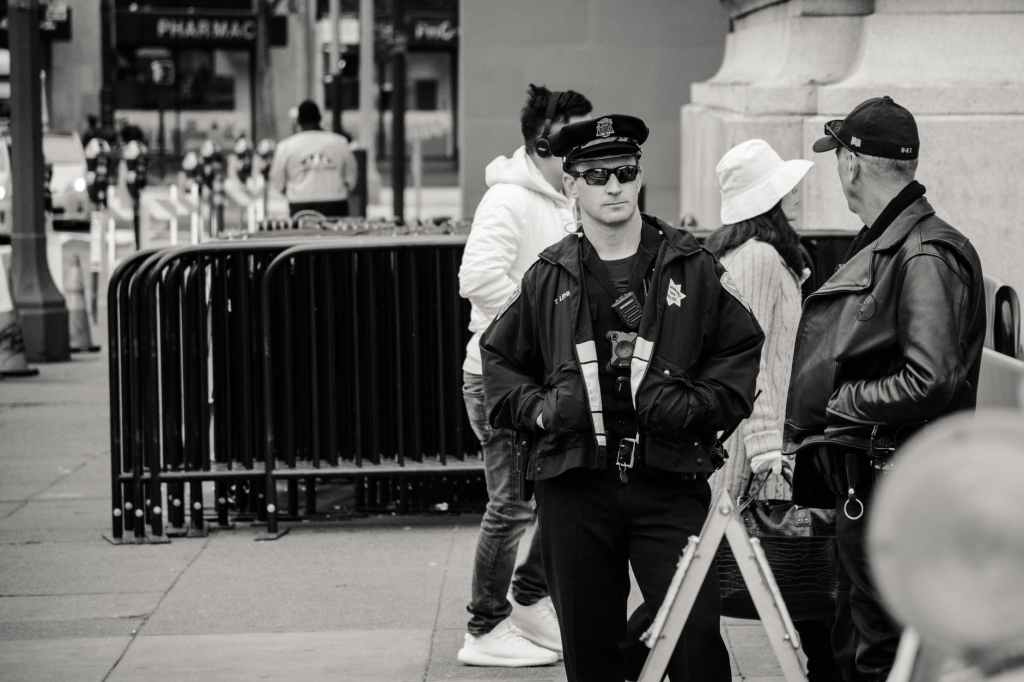
NIGHTWATCH
A security guard parks his patrol car and locks it. The neighborhood, Oak Park, has long been synonymous with crime in Sacramento. Sodium vapor streetlights cast their characteristic orange glow throughout the neighborhood. The ones that are working, anyway. He makes his way up to the door of the ramshackle house owned and operated by the county, one of many in the area that house indigent residents. This particular house is home to two families and is overseen by a single on-site staff member.
The streets are strangely quiet tonight, and the guard takes solace in that. He knocks on the side door of the house, and the overnight staff answers. A little ragged from taming the children in the common area — the family room — the staff smiles wearily and allows the guard inside. He surveys the bleak interior. The rooms are quiet, two children resting peacefully in the glow of the TV.
“How’s everything been tonight?” the guard asks, moving quietly to the sign-in sheet on the battered desk.
“S’okay,” the staff member responds, brushing a wayward strand of hair back toward her ponytail. She has a Bachelor’s degree in Social Work and is working toward her Master’s so she can begin a career as an advocate for families in need. “These kiddos’ve been pretty active since their dad left for work. They just calmed down before you got here.” The guard scribbles his signature on the sign-in log and straightens up.
“Anything happening tonight?”
“No, it’s been pretty quiet.” The staff member sits at the desk and validates his signature, takes a sip of cold coffee. The sound of nearby gunshots make both jump. The guard moves to the side door, hand going to the .40-caliber pistol on his hip. He doesn’t draw, but looks out the window. The staff member runs to the children and hustles them to the back of the house. No further gunshots are heard, but the screeching of tires signals the departure of the shooter. No sirens. No screams.
The guard cracks open the door and looks toward the front of the house. He’s fairly certain the shots came from the next street over, but doesn’t want to take the chance that the residents of the house are in danger. He keys the PTT button on the Nextel phone he carries to connect him to dispatch.
“Central, Sam-1 requesting backup. Gunshots in area. Standing post until clear.”
“Copy, Sam-1. George-2 not on shift yet. Can you clear on your own?”
The guard weighs the risks. Since he’s confident at this point that the shots were fired a street over, he decides to clear the area on his own.
“Affirmative, Central. Stand by.”
“Copy, Sam-1. Any units on the net, clear the air.”
The staff and her charges remain in the back of the house. The guard draws his weapon and moves out the side door, sweeping the muzzle to the rear of the house. Clear. He returns his attention to the front of the house. Moving slowly along the dilapidated stucco wall of the house, he keeps his pistol aimed forward, sweeping the entire area with his peripheral vision. No movement, a fan in the upper story of the apartments next to him the only sound. He checks left at the front of the house; all clear. He “slices the pie,” using the corner of the house as concealment, making sure he remains out of the sight of any assailants to the right of the house. All clear. He holsters his pistol.
“Central, Sam-1 code four.”
“Copy, Sam-1. All units, resume normal traffic.”
The guard walks back toward the side door of the house. As he’s just about to enter, a baseball-sized rock thunks on the porch. His head swivels toward where he thinks the rock came from, and a kid next to the fan in the apartment above laughs. The kid flips off the guard before retreating from the window.
The guard shakes his head, sighs, and enters the house, calling the all clear. The staff member enters from the back, shaken.
“Thank you,” she says, brushing the same strand of hair back again.
“You’re welcome. I’m gonna head out, you need anything?”
“Nah. Just a smoke would be helpful. I hate this neighborhood.”
“I hear ya. Stay away from the front, okay?”
“I will.”
The guard goes back to his patrol car, unlocks it, gets in, and heads toward the next house. Only four hours left.
THE PROFESSION
The story above is true, though some details have been changed to protect the identities of the families and the staff member. It happened to me ten years ago, when I worked as a private security guard (or security officer, if you ask those in the industry) for a contract patrol company in Sacramento. Events like this are all too familiar to many working as a security guard. It’s not all cheap suits in marble lobbies or cushy air-conditioned mall assignments.
The Bureau of Labor Statistics estimated in May 2017 that there were 1,105,440 people working as security guards in the United States alone. The employment numbers are expected to increase 6% by 2020. Sadly, the median pay in 2017 was approximately $12.93 per hour ($26,900 annually).
For many, the company these employees will work for offer inferior benefits and little to no paid time off. At that company, I had no benefits to speak of, and paid time off was reserved for those in salaried positions. At $13.00 per hour, I was driving around some of the sketchiest neighborhoods in Sacramento and, at times, having to insert myself into situations that would put to the test my inadequate training and ability to improvise. The scenario above is illustrative of the kinds of activity I could expect on any given night. And, if I had discharged that weapon in a “good shoot” — a legally defensible use of deadly force — my company would have fired me in a heartbeat to avoid any possible torts or criminal charges, leaving me on my own to retain counsel.
At $13.00 per hour.
PERCEPTIONS
Security guards are typically looked down upon by American society. They have no real power, save for those who work directly for employers such as the Sacramento County Sheriff’s Office or the Transportation Security Administration. Those entities, and others like them, grant limited police power to the guards so that they can effectively control the sites to which they are assigned. In his essay The Politics of Private Policing: No Force and No Legitimacy?, Massimiliano Mulone asserts that, “as private security officers and companies are likely to become increasingly involved in traditional police functions (most notably patrolling the public space), their lack of legitimacy and legal powers could significantly impede their actions in the future.” The bulk of private security guards, however, have only the ability to observe and report. It’s for this reason that people often test the limits of a guard’s patience largely by taunting them or disobeying property owner rules.
Then there are the outliers that actively do disservice to the profession, such as the self-styled “Paul Flart,” who gained notoriety in August 2018 for posting videos to his Instagram and YouTube accounts in which he farted. That’s all he did — recorded himself farting at his post. His employer was less than tickled by his actions and terminated him. Which, of course, he also recorded and posted to YouTube (https://www.youtube.com/watch?v=TVr8FvLataQ).
While in the industry, I attempted at every turn to bring a professional face to the streets. Clean-shaven, pressed uniform, shiny boots, clean gear, clean car, excellent reports. For 12 years I continued trying to do so, but in the end, I was beaten by intraoffice politics and the actions of guards like Paul Flart. People like the guard, related to an executive, who forgot to secure his pistol in his holster. As he took off at a run to retrieve something he’d forgotten in the office, his Beretta 92 FS leapt from the holster and clattered to the ground, sending me and the other supervisor scurrying for cover. Luckily, he was carrying the pistol in Condition 3 (magazine inserted, no round in the chamber), and we were spared a negligent discharge that would endanger us.
Around the nation, stories abound of guards asleep at their post, or challenging irritating morons with cameras that try to provoke the guard, or even guards actively stealing from the people they’re supposed to be protecting. In 2011, a security guard was arrested for burglarizing a home and toting away $8,000 worth of DJ equipment in the trunk of his patrol car.
INSIDER SUGGESTIONS
The industry-famous report, Private Police in the United States: Findings and Recommendations prepared by the RAND Corporation, published in 1971–1971, for crying out loud — highlighted problems that are still seen in the private security industry 47 years later. Of the most prevalent, Section VI is dedicated to the topic of personnel.
“The typical private guard is an aging white male, poorly educated, usually undertrained, and very poorly paid.” Yes, this is still a problem, and the lack of decent pay (addressed again below) draws few reliable people to the profession. What’s worse, most contract security firms don’t care and will do whatever it takes to fulfill the contract, whether or not they have the present means to do so. Which means supervisors will continue to find people napping, stealing, or performing other unsavory activities on post.
“Contract guards earn a marginal wage … and often work a 48-hour or 56-hour week to make ends meet. In-house guards receive … more than their contract counterparts, primarily because in-house security personnel tend to receive wage gains in line with those obtained by their non-security … fellow employees.” When I dropped out of the industry in 2013, a guard on post might earn upwards of $11.00 per hour. Not too shabby, eh? The problem is that the contract firms are usually charging upwards of $30.00-$45.00 per hour. The company is pocketing the remainder. And we wonder why so many guards seem ill-tempered.
“In our 1971 survey of 275 in-house and contract security employees … we asked their reasons for working at their present jobs … Fully 40 percent indicated that they had been unemployed and this was the best job they could find …” Startlingly, no, this hasn’t changed. Many of the guards with whom I was in contact were there just to earn a check. Sloppy uniforms, poorly maintained equipment, and bad attitudes abounded in the field. More than once I was told, “Bro, get off my back, I’m just here to get my money.”
For my part, as a former security industry professional, I have some suggestions of my own. Most of these will seem to be common sense to a good manager, but there appear to be few of those in the security industry as a whole.
1. Treat each employee as if they’re irreplaceable. Give them at least 50% of what is being charged to the client. Provide at least affordable medical and dental that doesn’t eat 20%-25% of their check. Offer encouragement and support, and follow through on the offer. Don’t offer lip service to your people as a catchy recruitment slogan.
2. Give better training. Yes, there are state mandates, but the training is insufficient for what the employee will encounter day-to-day. Training needs to occur on a quarterly basis, not annually, and the topics need to be engaging and have real-world application. And it needs to include soft skills (phone engagement and talk-off, in-person conversation and assistance, conflict resolution, report writing, etc.).
3. Allow for dialogue. Many supervisors and managers “don’t have time” to talk to their employees. Make time. I did, as both supervisor and manager, and I had better performance from my subordinates than any others on my team. The employees felt empowered when they could safely talk about a beef they had or a solution to a problem, and they felt even better when I addressed it with the office.
4. Educate your client on what is and is not allowable. Many clients don’t understand what a security guard can and cannot do. It’s the security company’s job to ensure the client understands what is allowable.
5. Educate the public on what is and is not allowable. This means that visitors to the client site need to be let known what is allowed onsite. Don’t presume that the rowdy customer will fully grasp that the security guard is allowed to remove them forcibly from the premises if they start swinging (based upon the client’s rules, of course). Security personnel, through proper training, should be able to clearly and concisely explain to any person, from any background, what the rules are and what the consequences will be if the rules are not followed — before the contact escalates to a tussle.
6. Never discipline in front of the guard’s peers or customers. I shouldn’t need to explain, but here I go anyway. This is bad leadership, bad management, bad peopling. Do. Not. Do. This. The supervisor or manager that dresses down an employee in full view of peers or the public will look and sound like — and in all reality, probably is — a bully. No one likes or respects a bully, and you will lose all credibility.
Wayne Campbell is a freelance writer based in the Sacramento area.
CITATIONS
1. Kakalik, James S. and Sorrel Wildhorn, Private Police in the United States: Findings and Recommendations. Santa Monica, CA: RAND Corporation, 1971. https://www.rand.org/pubs/reports/R0869.html. Also available in print form.
2. Mulone, Massimiliano (2016), The Politics of Private Policing: No Force and No Legitimacy?, in Mathieu Deflem (ed.) The Politics of Policing: Between Force and Legitimacy (Sociology of Crime, Law and Deviance, Volume 21) Emerald Group Publishing Limited, pp.277–293
3. “Security Guard Arrested For Residential Burglary While On Duty.” CBS Sacramento. July 12, 2011. Accessed August 28, 2018. https://sacramento.cbslocal.com/2011/07/12/security-guard-arrested-for-residential-burglary-while-on-duty/.
Copyright © 2018 Wayne Campbell. All rights reserved. Also available at https://medium.com/@waynecampbell/the-sad-state-of-private-security-d5a121be32de
 Wayne Campbell